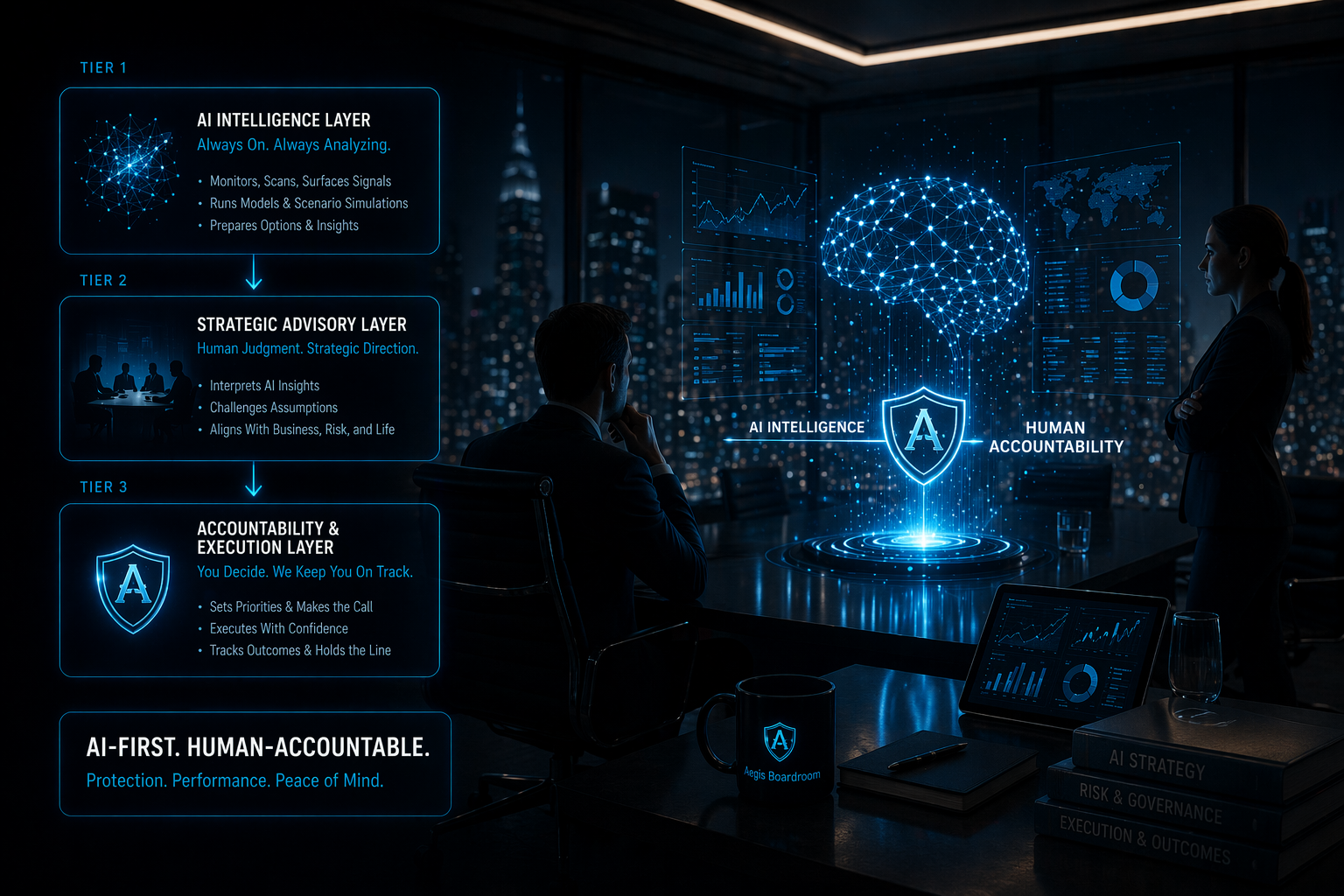
AI-First, Human-Accountable: How the Tiered Advisory Model Actually Works
Most advisory services force you into one pricing tier and one delivery model. You pick the retainer, the retainer picks everything else. Same human cadence at every stage. Same cost structure whether you are pre-revenue or pushing through a Series B.
That is backwards. The support you need at $500K ARR is not the support you need at $15M, and neither is the support you need during a founder exit. The advisory model has to adjust to the business, not the other way around.
Here is why we built three tiers, what each one is actually for, and what the research says about when each model delivers.
Why One-Size Advisory Breaks Down
The traditional fractional model is simple: pay a retainer, get a named human a few hours per week, end of story. Monthly fractional CFO retainers typically run $3,000 to $15,000, with most growing service businesses investing $4,000 to $12,000 per month according to K38 Consulting's 2025 pricing guide.
That is a legitimate model. It also has a hard ceiling. You are paying for a person's hours, which means the model cannot deploy outside those hours, cannot cover more than one or two functions, and cannot scale down when your needs are light or up when your needs spike.
Meanwhile, the number of fractional leadership professionals in the U.S. doubled from 60,000 in 2022 to 120,000 in 2024, and Gartner projects more than 30% of midsize enterprises will have at least one fractional executive on retainer by 2027. The demand is obvious. The delivery model has not kept up with what growing companies actually need.
What AI Changes in the Advisor Economics
Before explaining the three tiers, it helps to understand what AI actually changes in advisory work. This is not a marketing claim. It shows up in the research.
Harvard-linked studies indicate management consultants leveraging AI tools are 25.1% more productive, and industry analysis shows that when a 10-week project can now be executed in 6 weeks, the firm's cost base drops 30 to 40%. Consulting industry commentators now describe AI-augmented advisors as "as productive as three consultants", and Big Four firms are visibly reorganizing around this shift, with KPMG UK shrinking its 2023 graduate class by 29%.
Translated: a seasoned advisor running on AI infrastructure can serve more clients, go deeper with each one, and respond faster than the same advisor could without AI. The economics enable something the old model could not: tiered delivery priced to what a client actually needs, not a flat rate that has to assume the worst case.
Tier 1: Aegis Assist, AI-First
Aegis Assist is the AI-first tier. The AI runs all advisory functions day-to-day. A seasoned human expert is configured as the backstop, notified when the AI flags high-stakes situations or when you explicitly escalate.
This is not "cheap advisory." It is the right model for a specific situation: you need intelligence across multiple C-suite functions (finance, marketing, technology, operations, security) but you do not need a human voice in the loop every week. You need a daily briefing, not a weekly call.
Human advisor time sits at around an hour per month, reactive only. The AI carries the load. When it surfaces something it cannot safely handle, the human steps in.
Who it actually fits: Nonprofits on a mission budget. Solo founders. Pre-revenue and early-stage companies. Leaders who want to experience the platform and see the output before committing to a deeper engagement.
Tier 2: Aegis Advisory, Human-Configured
Aegis Advisory is the core tier. A named, seasoned advisor engages actively on a monthly or bi-weekly basis to configure, calibrate, and direct the AI advisory system. Between sessions, AI delivers daily guidance and proactively surfaces insights.
This is the tier most growth-stage companies should start at. The named advisor owns your strategic context, knows your business, and tunes the AI to fit your specific operating reality. Between sessions, you are not on your own. The AI is running off the configuration your advisor built, so the daily output reflects the strategy you agreed on.
Human advisor time: 4 to 6 hours per month. The AI-augmented leverage research explains why this works. An advisor operating at roughly three times the productivity of a traditional fractional hire can actually deliver the depth of a much larger engagement at a reasonable price point.
Who it actually fits: Growth-stage SMBs in the $2M-$20M revenue range. Professional services firms. VC-backed startups from Seed through Series A. Family businesses beginning succession planning.
Tier 3: Aegis Boardroom, Human-Accountable
Aegis Boardroom is the heaviest tier. A dedicated team of named senior advisors, each of whom has actually held the C-suite role they now supervise, engaged weekly across every function. CFO, CMO, CTO, COO, CISO. Active board meeting preparation and attendance. Real-time crisis response. Monthly Life Integrity advisory call.
This is the tier for companies in an inflection moment. PE portfolio companies under value creation pressure. Family businesses in active succession. VC-backed companies past Series B. Professional services firms in transformation. Growth-stage SMBs at a fork where the wrong decision costs a year.
Human advisor time: 15 to 25 hours per month across the team. This is the tier where cost stops being the primary consideration and outcomes become the primary consideration. Compared to a full-time CFO at a median total compensation of $375,000 to $450,000, for one function, Aegis Boardroom covers the full C-suite with AI handling the 24/7 monitoring.
Who it actually fits: PE portfolio companies. Family businesses mid-transition. VC-backed companies at Series B and beyond. Any company where a named advisor on each major function is the right level of accountability.
The Layer That Runs Across All Three
Something worth naming explicitly: the Life Integrity Engine runs across every tier. Whether you are on Assist, Advisory, or Boardroom, recommendations pass through the same integrity filter that declines to optimize the business at the expense of the person running it.
This is not a Boardroom-only feature. It is the default. The reasoning is the same at every tier: the company cannot outperform the person running it, and the research on founder burnout makes it clear that leaders who set work-life boundaries are nearly three times less likely to experience high burnout. Protecting the founder is not optional at any price point.
How to Pick Your Tier
Three questions get most people to the right starting tier.
Question one: How much human-in-the-loop do you actually need each month? If the answer is "some, but not every decision," Advisory. If the answer is "I want a weekly cadence with a named advisor on every function," Boardroom. If the answer is "I want the platform running, and a human only when it matters," Assist.
Question two: Where is the business right now? Pre-revenue or early: Assist. Growth stage ($2M-$20M): Advisory. Inflection moment (PE acquisition, succession, Series B, crisis): Boardroom.
Question three: What is the cost of being wrong on this decision? If a wrong strategic call this quarter costs you a year of growth, you want more human accountability, not less. That is Boardroom. If you are learning what AI-augmented advisory looks like, Assist is the right starting point.
Most clients start at Advisory. A meaningful share start at Assist and move to Advisory within six months once they see the output. Boardroom is the right first stop only when the situation demands it, not as a default.
That is the model. AI-first where it fits. Human-configured where it fits. Human-accountable where the situation requires it. And Life Integrity running across all three.
Not sure which tier fits your situation?
A 30-minute discovery call is the fastest way to find out. No pitch deck. Just a conversation about where you are and what level of advisory actually makes sense.
Find Out MoreSources
- K38 Consulting: Fractional CFO Pricing Guide 2025
- Fractionus: Fractional Work Statistics 2025, Income Data, Market Growth & Client Trends
- Vendux: The Growing Phenomenon of Fractional Executives, By the Numbers (citing Gartner forecast)
- Consulting Quest: How AI Is Changing Consulting Economics (citing Harvard research)
- Future of Consulting: 2026 Consulting's AI Revolution Update
- Bennett Financials: Understanding Fractional CFO Cost (citing full-time CFO compensation data)
- Sifted: More than half of founders experienced burnout last year (2025 survey)